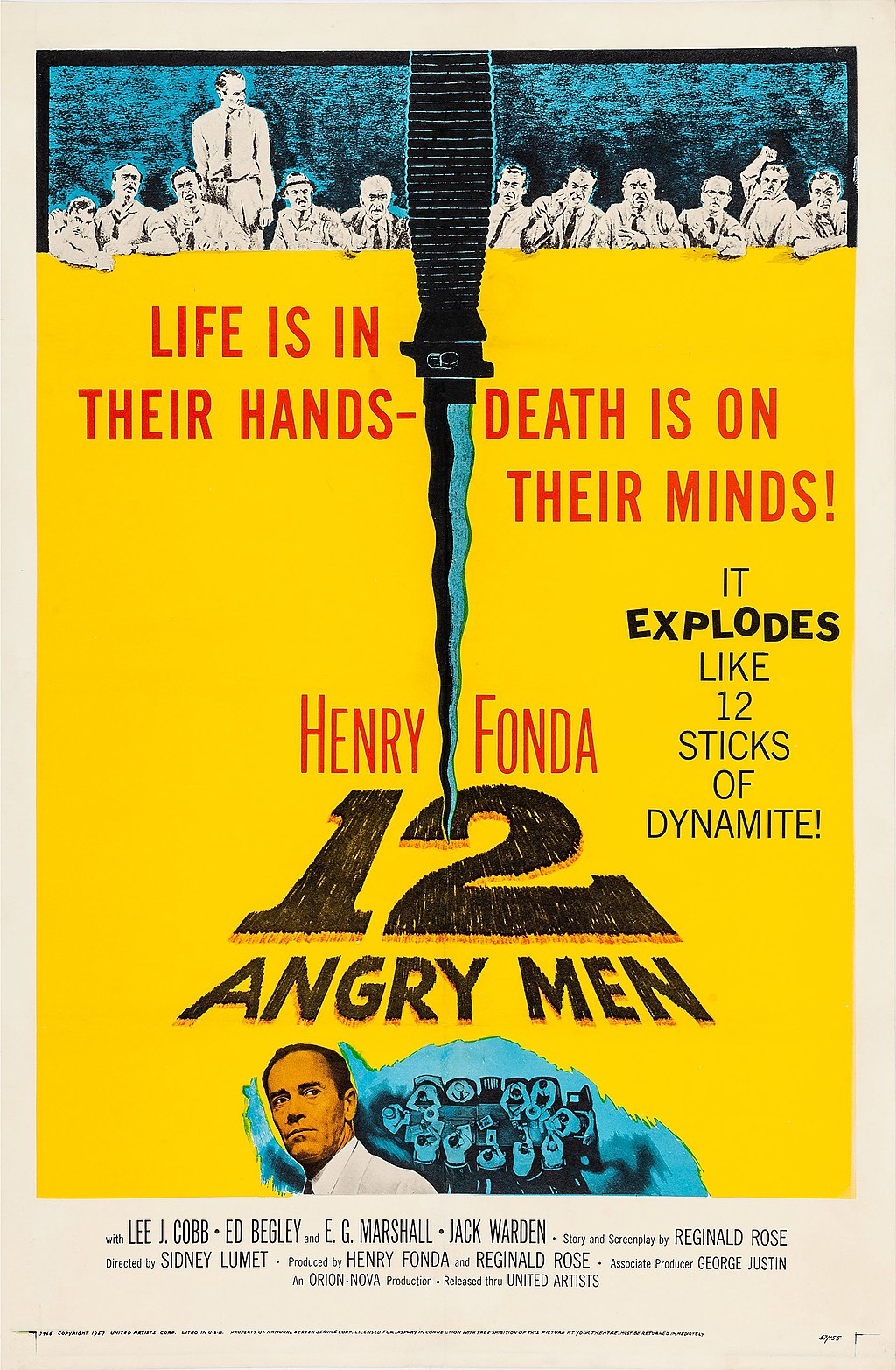
Ah, “12 Angry Men,” a cinematic masterpiece that proves the power of one man’s conviction can change the course of justice. This 1957 classic, directed by Sidney Lumet and starring the inimitable Henry Fonda, takes place almost entirely within the confines of a jury room, where twelve men must decide the fate of a young man accused of murder. What follows is a gripping exploration of the American legal system, the nature of prejudice, and the strength of the human spirit.
The story begins on a sweltering summer day in New York City, where twelve jurors are tasked with determining the guilt or innocence of a young Puerto Rican man accused of stabbing his father to death. At first glance, the case seems open and shut – the evidence is overwhelming, and eleven of the jurors are ready to convict. But one man, Juror 8 (Fonda), has his doubts.
As the deliberations begin, Juror 8 finds himself at odds with his fellow jurors, each of whom brings their own biases and preconceptions to the table. There’s Juror 3 (Lee J. Cobb), a hot-headed businessman with a personal vendetta against the accused; Juror 10 (Ed Begley), a bigoted garage owner who sees the defendant as nothing more than a “them”; and Juror 7 (Jack Warden), a wisecracking salesman more interested in catching a baseball game than serving justice.
But Juror 8 refuses to back down. In a series of powerful scenes, he methodically dissects the prosecution’s case, pointing out inconsistencies and raising doubts about the reliability of the witnesses. He challenges his fellow jurors to look beyond their prejudices and consider the possibility that the defendant may be innocent.
As the deliberations wear on, tensions mount, and tempers flare. In one particularly heated exchange, Juror 3 lunges at Juror 8, his face contorted with rage. But Juror 8 remains calm, his quiet strength a beacon of reason in a sea of chaos.
Slowly but surely, Juror 8’s arguments begin to sway his fellow jurors. One by one, they change their votes, until only Juror 3 remains steadfast in his belief of the defendant’s guilt. In a powerful moment of self-reflection, Juror 3 breaks down, revealing the true reason behind his bias – a troubled relationship with his own son.
In the end, the jury returns a verdict of not guilty, a testament to the power of reasonable doubt and the importance of impartial justice. The film ends with a poignant moment of connection between Juror 8 and Juror 9 (Joseph Sweeney), an elderly man who had been one of the first to change his vote. It’s a reminder that even in the darkest of times, there is always the possibility of understanding and compassion.
“12 Angry Men” is a film that resonates as powerfully today as it did over six decades ago. Its themes of prejudice, groupthink, and the importance of standing up for one’s beliefs are as relevant now as they ever were. Lumet’s direction is masterful, his use of claustrophobic close-ups and tense camera angles creating an atmosphere of almost unbearable intensity.
But it is the performances that truly make the film shine. Fonda is a revelation as Juror 8, his quiet strength and unwavering moral compass a beacon of hope in a world of cynicism and doubt. And the rest of the cast is equally impressive, each bringing a unique perspective and depth of character to their roles.
In the end, “12 Angry Men” stands as a testament to the power of storytelling to challenge our assumptions and change our hearts and minds. It’s a film that demands to be seen, a powerful reminder that justice is not always easy, but it is always worth fighting for. So if you’re in the mood for a thought-provoking, emotionally charged exploration of the human condition, look no further than this timeless classic. Just remember, as Juror 8 so eloquently puts it, “it’s always difficult to keep personal prejudice out of a thing like this. And wherever you run into it, prejudice always obscures the truth.”
5/5 – This is a classic for a reason – the way Juror 8 slowly brings people around their biases to see the evidence without that bias is a masterclass in persuasion. Seeing each of the jurors face themselves in the proverbial mirror and change their mind was a moving experience and hearkens back a time when people could have their minds changed instead of now where it seems people are committed to their dogmatic views and will not change for anything. I can’t see this happening in 2024 – the rest of the jurors would hold on to their biased views and it would end up a hung jury. Regardless of the current social mindset this movie was superbly acted and shot – it all happens in one room and it feels confined – so much that the actors open the windows to let in air and you feel what they must have felt in that hot room all day. One final note: for 30 years I thought it was Jimmy Stewart who was juror 8 and to my surprise when I watched it this time it was Henry Fonda!