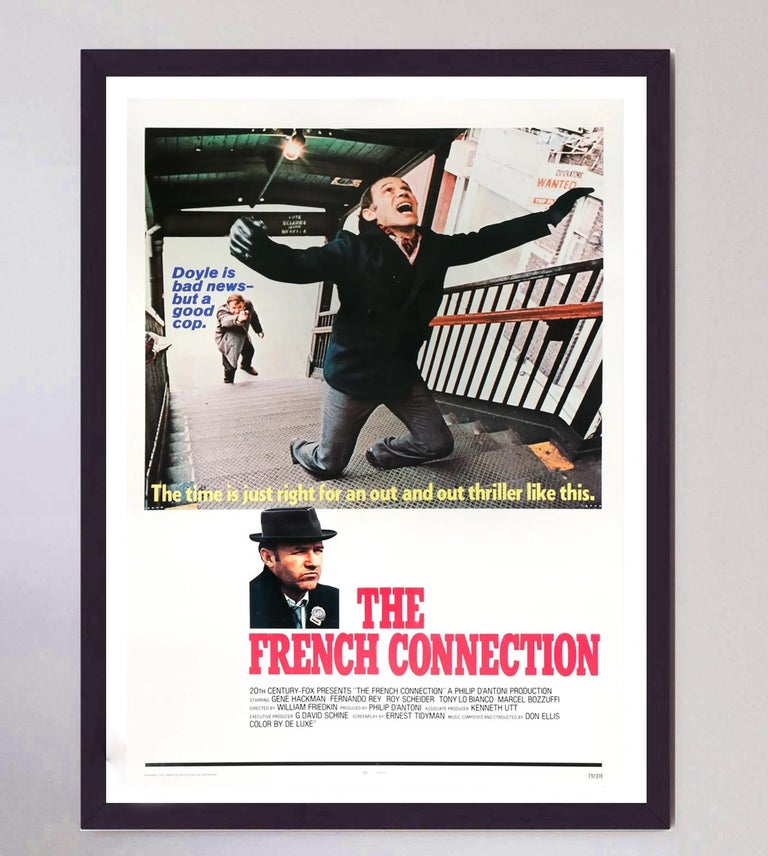
The French Connection

When Drug Busting Meets Defensive Driving 101

Ever wonder what would happen if you gave the world’s angriest cop a badge, a car, and an obsession with French drug dealers? Meet Jimmy “Popeye” Doyle (Gene Hackman), a New York detective whose approach to police work makes Bull Connor look like Officer Friendly.

Doyle and his partner Buddy “Cloudy” Russo (Roy Scheider) stumble onto what might be the biggest heroin deal in history while doing their usual routine of harassing random civilians and treating the Constitution like a suggestion list. They spot well-dressed Sal Boca hanging out at a nightclub with known criminals, which in early 1970s New York was like noticing water is wet, but Doyle’s gut says there’s more.

Enter Alain Charnier (Fernando Rey), a sophisticated French criminal who makes other drug lords look like street corner dealers. He’s smuggling $32 million worth of heroin into New York inside a car being brought over by unsuspecting TV personality Henri Devereaux. Charnier is everything Doyle isn’t – sophisticated, patient, and owns more than one sport coat.

The film follows Doyle and Russo as they conduct the world’s most aggressive stakeout. This includes a surveillance sequence that consists mainly of our heroes freezing their badges off while eating what appears to be the worst takeout in New York (which is saying something). Doyle’s dedication to the case extends to following Charnier around the city in a cat-and-mouse game that probably violated every transit authority regulation in existence.

This leads to the film’s centerpiece: a car chase that makes the Fast & Furious franchise look like a driver’s ed video. Doyle, pursuing a hijacked elevated train carrying a hitman, creates a new category of traffic violation while terrorizing Brooklyn in a brown Pontiac. The scene was shot without permits, which means those terrified pedestrians jumping out of the way weren’t acting – they were just trying to get their groceries home.

Things get messier when the feds get involved, leading to jurisdictional disputes that make interdepartmental meetings look like group therapy. The whole operation nearly falls apart multiple times, primarily because Doyle has the diplomatic skills of a hangry rhinoceros. It all culminates in a showdown at an abandoned warehouse (because where else would you conduct a major drug bust?) that goes about as smoothly as you’d expect when Popeye Doyle is involved.

The Verdict

What I Love:

  • Gene Hackman making “angry cop” into an art form worthy of the Louvre
  • A car chase that probably sent New York’s insurance rates up for decades
  • Cinematography that makes you want to take a shower, but that’s the point
  • A police procedural that’s about as procedural as a food fight
  • The most aggressive use of a porkpie hat in cinema history

What Could’ve Been Better:

  • Might make you distrust anyone wearing nice clothes in New York
  • Will definitely affect your opinion of elevated trains
  • Could make you question the effectiveness of police sensitivity training

“The French Connection” is like if you took a documentary about police work and replaced all the paperwork scenes with adrenaline. It won five Academy Awards, including Best Picture, proving that sometimes the Academy voters appreciate a good car chase as much as a period drama.

Rating: 5 out of 5 illegally parked surveillance vans

P.S. – After watching this, you might want to take the subway. Actually, after that chase scene, maybe just walk.
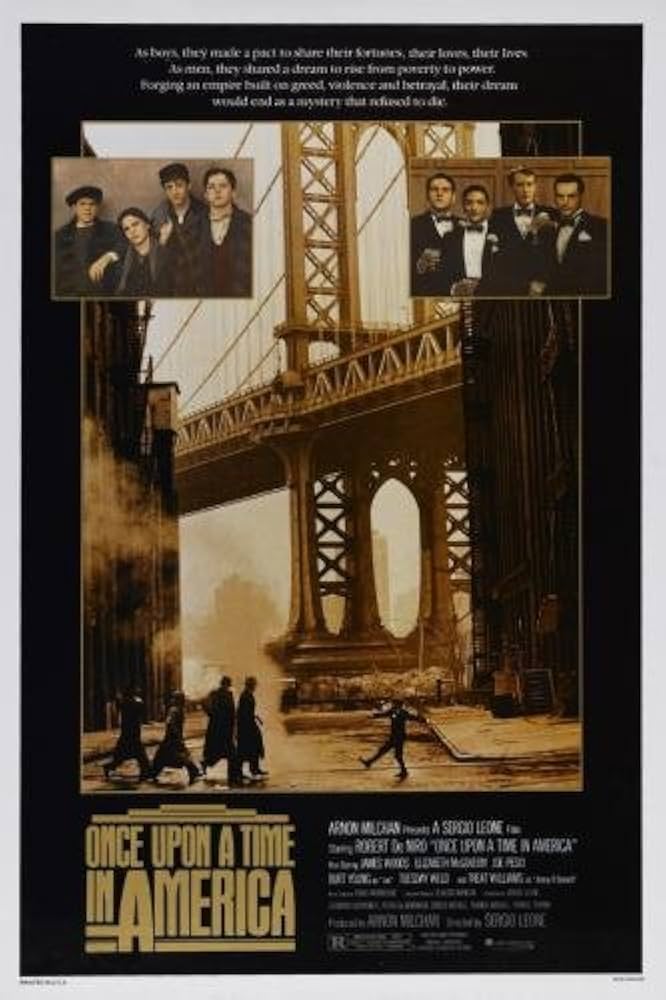

Once Upon a Time in America

The Longest Game of Criminal Musical Chairs Ever Filmed

Looking for a nice, straightforward gangster movie? Maybe try Goodfellas. Sergio Leone’s final film is what happens when you take a crime epic, throw it in a blender with a pocket watch, and hit the “timeline confetti” button. It’s nearly four hours of past, present, and “wait, when are we now?”

Our story follows David “Noodles” Aaronson (Robert De Niro) through three primary time periods: the 1920s (child gangster edition), the 1930s (successful gangster edition), and 1968 (confused old gangster edition). The film opens with Noodles in 1933 fleeing from gangsters after apparently getting his friends killed and stealing their money. Because that’s what friends are for, right?

Cut to 1968, where an older Noodles returns to New York after receiving a mysterious letter. He looks like he’s spent the last 35 years trying to figure out what exactly happened in this movie, and honestly, same. He visits a still-operating speakeasy run by Fat Moe (Larry Rapp), whose sister Deborah (Elizabeth McGovern) was the love of Noodles’ life – at least when he wasn’t too busy ruining everything.

Through a series of flashbacks more complex than a quantum physics textbook, we learn about young Noodles (Scott Tiler) and his childhood friend Max (Rusty Jacobs). They start their criminal career in Manhattan’s Lower East Side, where they meet Patsy and Cockeye, forming a gang that makes the Little Rascals look like model citizens. Their early adventures include setting a rival’s newspaper stand on fire, which seems like a lot of effort to avoid reading the morning news.

Young Noodles goes to prison for killing a rival gang member, and when he gets out, he reunites with his now-grown friends. Adult Max (James Woods) has become more ambitious than a Silicon Valley startup founder, leading the gang into bigger scores during Prohibition. The adult gang’s operations are successful enough to make them rich, but Max keeps pushing for more, because apparently being a wealthy criminal during the Depression isn’t enough of an achievement.

The film weaves through their rise to power, complicated by Noodles’ obsession with Deborah and Max’s increasingly risky schemes. There’s a subplot about a union leader named Jimmy O’Donnell that’s more confusing than trying to assemble IKEA furniture without instructions. Meanwhile, Noodles’ relationship with Deborah goes about as well as you’d expect from someone whose emotional intelligence is somewhere between a rock and a slightly smaller rock.

Everything supposedly culminates in a betrayal in 1933 that leads to the deaths of Max, Patsy, and Cockeye. But because this is Leone, nothing is what it seems. In 1968, Noodles discovers that Max faked his death, stole the gang’s money, and became a powerful political figure named Secretary Bailey. It’s like the worst high school reunion surprise ever.

The Verdict

What I Love:

  • A narrative structure that makes Christopher Nolan say “maybe that’s a bit complicated”
  • Ennio Morricone’s score that makes even scenes of people walking seem epic
  • De Niro proving he can brood in multiple decades
  • James Woods at peak James Woods-iness
  • Cinematography that makes New York look like a beautiful dream, even when it’s a nightmare

What Could’ve Been Better:

  • Might require a flowchart to follow the timeline
  • Will definitely affect your ability to tell what year it is
  • Could make you suspicious of any childhood friend who seems too ambitious

This is a film that treats time like a suggestion rather than a rule. It’s less “Once Upon a Time” and more “Several Times at Once in America.” At nearly four hours long, it’s the kind of movie that makes Lord of the Rings look like a TikTok video.

Rating: 5 out of 5 opium-induced time jumps

P.S. – If you’re planning to watch this, maybe take notes. Or better yet, bring a professional timekeeper.