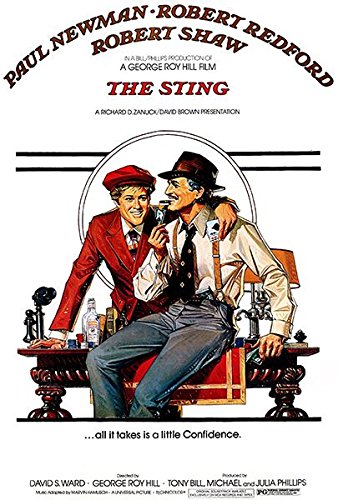
The Sting

When Revenge is Best Served with Style

Need to get revenge on a murderous crime boss? Try elaborate confidence games and ragtime music! At least that’s the approach Johnny Hooker (Robert Redford) takes after his partner gets killed by enforcer Loretta Numbers for scamming a numbers runner connected to crime boss Doyle Lonnegan (Robert Shaw).

Hooker seeks out Henry Gondorff (Paul Newman), a master con artist who’s “retired” in the same way that Michael Jordan was “retired” – which is to say, not really. Gondorff, despite nursing the kind of hangover that would kill a lesser man, agrees to help set up the ultimate con: a fake betting parlor designed to separate Lonnegan from his money and his smugness simultaneously.

What follows is a masterclass in the long con, featuring more moving parts than a Swiss watch factory. Gondorff infiltrates Lonnegan’s high-stakes poker game on a train, winning big with cheating that’s so obvious it would make a Vegas casino blush. This gets Lonnegan’s attention and, more importantly, his anger – something Gondorff and Hooker plan to leverage like a financial advisor with inside information.

The duo assembles a team of con artists who make Ocean’s Eleven look like amateur hour. They create an entirely fake off-track betting parlor, complete with a cast of characters that would make Broadway jealous. There’s Kid Twist (Harold Gould) posing as a Western Union clerk, giving out “sure thing” horse racing tips that are actually delayed results. The Erickson (Eileen Brennan) provides the female touch, while Eddie Niles (John Heffernan) plays the part of a disgruntled betting parlor employee willing to help Lonnegan “cheat” the house.

Meanwhile, FBI Agent Polk (Dana Elcar) is pursuing Hooker for killing a pursuer who was actually offed by someone else (it’s complicated), and corrupt cop Lieutenant Snyder (Charles Durning) is trying to get his cut of whatever action Hooker’s running. It’s like a chess game where half the pieces are actually checkers in disguise.

The con builds to a magnificent crescendo involving a fake shooting, a betting parlor raid that’s actually staged, and Lonnegan losing half a million dollars (in 1936 money!) to a horse that already lost. The beauty of the con is that Lonnegan can’t even go to the police because everything he tried to do was illegal anyway.

The Verdict

What I Love:

  • Newman and Redford’s chemistry that makes other screen partnerships look like blind dates
  • David S. Ward’s script that’s more intricately plotted than most retirement plans
  • Marvin Hamlisch’s adaptation of Scott Joplin’s ragtime music that makes white-collar crime seem downright jaunty
  • Period details so perfect you’ll check your calendar to make sure it’s not 1936
  • A plot twist ending that M. Night Shyamalan probably studies like religious text

What Could’ve Been Better:

  • Might make you overly suspicious of any gambling establishment
  • Will definitely affect your ability to play poker with a straight face
  • Could make you question why your revenge plans aren’t this stylish

“The Sting” pulls off the ultimate con: making audiences root for criminals while tapping their feet to ragtime music. It won seven Academy Awards, proving that sometimes crime does pay, as long as it’s fictional and features really good-looking people.

Rating: 5 out of 5 marked cards

P.S. – If someone named Kid Twist offers you horse racing tips, maybe check the timestamps first.
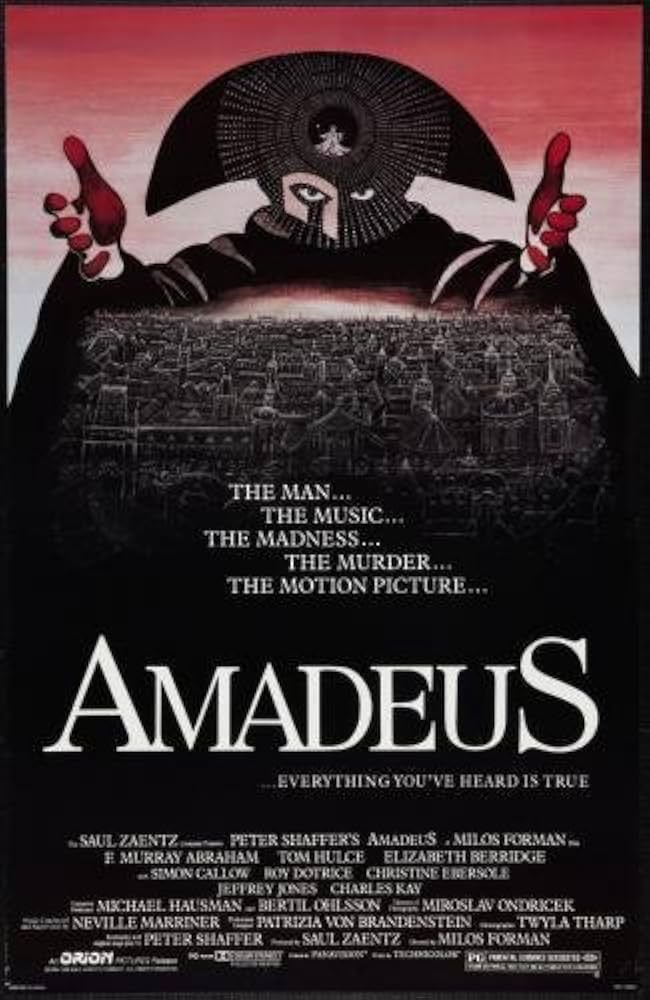

Amadeus

Amadeus: When God’s Favorite Composer Was His Least Favorite Human

Meet Antonio Salieri, a man who had the misfortune of being a pretty good composer in the same era as a certifiable genius. It’s like being a decent amateur juggler who has to follow someone juggling chainsaws while riding a unicycle. Blindfolded.

The film opens with elderly Salieri (F. Murray Abraham) attempting suicide while screaming apologies to Mozart for murdering him. This leads to him being committed to an asylum, where he tells his story to a young priest who probably wasn’t expecting his day to include a feature-length confession about musical jealousy and divine betrayal.

Through Salieri’s incredibly biased narration, we meet Wolfgang Amadeus Mozart (Tom Hulce), whose laugh sounds like a hyena that just discovered nitrous oxide. Mozart arrives in Vienna as the most talented brat in musical history – a genius composer who also happens to be a giggling, cursing, drinking manchild with a thing for potty humor. Imagine if you combined Einstein’s brain with a frat boy’s personality, then gave him a wig.

Salieri, who has dedicated his life to God and music (in that order), can’t handle the fact that the Almighty has chosen to give his divine gift to this “obscene child.” It’s like watching someone who spent decades practicing their craft get upstaged by a natural talent who doesn’t even bother to warm up. Mozart composes masterpieces the way most people doodle – without effort and often while doing something else entirely.

The film follows Mozart’s career in Vienna, where he manages to offend pretty much everyone who could help his career. He’s commissioned to write an opera, and decides the perfect subject would be a comedy about life in a harem, because nothing says “court approval” like sexual innuendo in Turkish costumes. Meanwhile, Salieri plots Mozart’s downfall while simultaneously being the only person who truly appreciates the genius he’s trying to destroy.

Mozart’s life starts to unravel faster than a cheap wig. His father dies (appearing later as a terrifying figure in a mask to commission the Requiem), his wife Constanze (Elizabeth Berridge) leaves him, and he’s reduced to teaching piano lessons to “squealing children” for money. Salieri, seeing his chance, disguises himself as Mozart’s dead father and commissions a Requiem Mass, planning to steal it and reveal it as his own composition at Mozart’s funeral – because nothing says “mentally stable” like planning to premiere your stolen masterpiece over your rival’s dead body.

The film builds to Mozart racing against time and his own deteriorating health to complete the Requiem, while Salieri pretends to help him while actually helping him die faster. It all culminates in one of cinema’s greatest sequences, as Mozart dictates his Requiem from his deathbed to Salieri, who writes it down while probably thinking “I could have written this… okay, no I couldn’t.”

The Verdict

What I Love:

  • F. Murray Abraham making musical jealousy into high art
  • Tom Hulce’s laugh, which should have gotten its own Oscar nomination
  • The most beautiful soundtrack in film history (thanks, Wolfgang)
  • Costume design that makes modern fashion weeks look understated
  • MiloÅ¡ Forman’s direction making classical music sexy before it was cool

What Could’ve Been Better:

  • Might make you feel bad about quitting those piano lessons
  • Will definitely affect your ability to listen to “Eine Kleine Nachtmusik” without giggling
  • Could make you question every gift you thought God gave you

“Amadeus” is less about historical accuracy and more about the agony of being second-best in a field you’ve dedicated your life to. It’s like a sports movie where the antagonist is the narrator, God is the referee, and Mozart is that guy who shows up without training and breaks all the records.

Rating: 5 out of 5 powdered wigs

P.S. – After watching this, you might want to listen to Mozart’s Requiem. Just don’t commission one yourself.