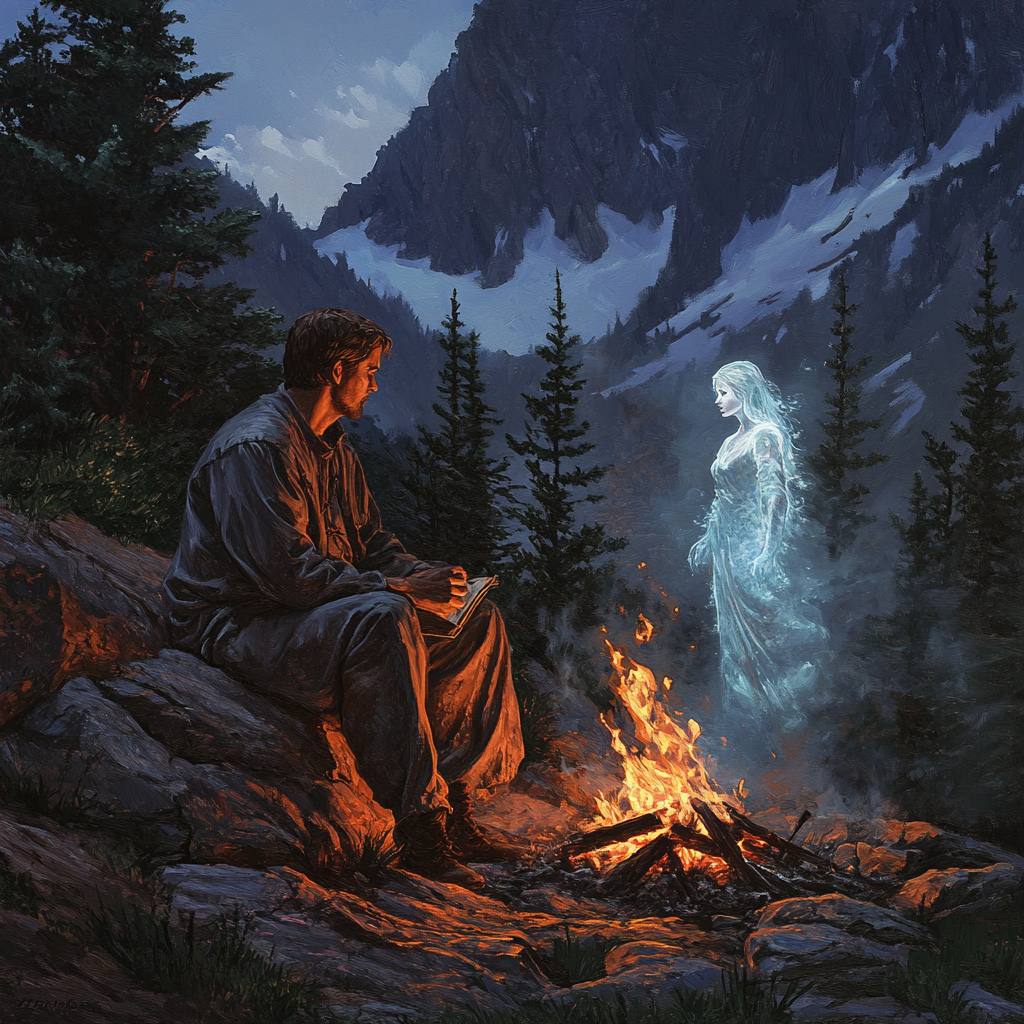
Chapter One

Caldren was lost.

Walking along a ridge he consulted the weathered map in his hand. Up until this point the map was leading him unerringly towards the destination. He left his entire life behind on the chance that this map and the journal it was folded into were real and he didn’t know what he would do if it turned out otherwise.

He was getting tired – his life as a scholar generally did not include athletic pursuits and the scramble across the rock spree and the climb to the ridge had left him sore and exhausted. The trail was clearly marked up until he got to this ridge and then the paths that were supposed to be were instead dense thickets and scrub pines and twisty mountain pathways that all seemed to circle back on each other. Trying to catch his breath in the thin mountain air he sat down heavily on a felled tree and stared at the map as if he looked at it long enough it would give up its secrets.

He glared at the dense overgrowth and grumbled to himself that he should have brought that sword his father had given him. He had never followed his father and brother into the military, but at least a sword would have been useful for cutting through the dense undergrowth. Perhaps the trail was simply overgrown and he needed to cut his way to his destination. He unsheathed his knife from its belt and stared morosely at it – it would take weeks to try to cut through with the knife which was already pretty dull from cutting wood for the evening fires.

The sun was setting soon and the wind was picking up. Caldren pulled his scholars robes from his pack and put them on. He knew the nights up here would be brittle and as his breath puffed into the night air and started a small campfire outside of a sheltered spot amidst the boulders. He didn’t think anyone was around to see the light of the campfire but he shielded it anyway just in case. He wasn’t doing anything technically wrong but he wanted to avoid any entanglements with imperial troops or bandits who would rob him of his already meager possessions.

Settling in for the night he took out his map again. It was yellowed from age and was annotated in a language he didn’t recognize, which was unusual for him as languages was one of the few things he truly excelled at. He was still unsure what he had gotten himself into. After years of searching for any information on the old magic an imperial officer shows up and just hands him a book detailing a mysterious place in the mountains that might be a lost school? It seemed too easy and he was definitely worried that it was a trap and if he did find the location imperial seekers would appear from behind the scrub pines to capture him.

Shaking his head, Caldren picked a random page in the book and started reading. This is something that he had been trying to uncover for a decade now. Magic – real magic like the mages of old. Not the imperial magic so tightly controlled or the hedge witches hiding in the wilderness. The magic spoken of in the tales his mother would tell him at night by the hearth.

Caldren loved these stories and they filled his boyhood imagination with wonder which lead him to pursue a life as a scholar instead of joining the militia as his father had wanted. He spent his days at his duties as an imperial scholar writing books with the words he was given and managing the library at the imperium. It was during a routine cataloging of captured books that he first found the mention of the school and the library. He was reading a pretty straightforward accounting of a merchant guild meeting when there was an entry detailing a funding request for an explorer who claims to have found Aethervale – the mythical location of the library of Temerith. The entry just notes their name as Malcom Sterling and that they granted him the necessary funds in return for first right to books found in the library.

Malcolm Sterling, the leader of the doomed Blackwood company. Everyone had heard the story of how the fabled company disappeared on its way back from one of their expeditions. Some of their company were found at the edges of the Bonechime woods their bodies refusing to rot away – their sightless eyes still facing the wood. Caldren had always thought the stories were fabricated to keep people away from the Bonechime woods but the more he read the more unsettled he became. There was something wrong with that place. It got its name from the sounds that came from the forest when the wind blew through it – a discordant knocking that seemed to follow no pattern but seemed deliberate.

Caldren suspected something else happened to the Blackwood Company. He couldn’t shake the feeling that the Imperial seekers had found out what Malcolm was attempting to do and took steps to ensure that the knowledge remained hidden. Caldren recalled the legends of Temerith and they all seemed to agree that it cannot be found unless it wants you to find it. Caldren always thought that was strange ascribing intent to a building but the legends were all pretty consistent. He wasn’t sure how they ended up hundreds of miles from their original destination however, and the mystery of that is part of what was keeping the legend alive.

Caldren closed the book and threw some more wood onto the small fire. He stared out into the darkening sky through the hazy blue smoke trying to figure out the mystery of this place. He always loved solving puzzles he was persistent when chasing down ideas and he has this unusual ability to remember things he has read clearly. He sorted through all the things he knew about this place trying to tease out a way to gain access.

Before the rise of the empire Temerith was the place mages went to study and learn amongst their peers. The biggest feature of the place was its massive library. The legends claim that you couldn’t ever enter the library itself as it was a stronghold built to protect knowledge. You’d have to speak to the librarians and they would find you the knowledge you sought. The legends here differ as a few claim the librarians were a subset of mage who specialized in managing the library while others claim that the librarians were magical constructs. One thing the legends all agree on were the clockwork archivists – metallic automatons who would gather and sort the books but also serve as guardians. There were a few descriptions of the in some of the books he’d read and they sounded terrifying. Fabricated from some sort of metallic alloy they stood seven feet tall and moved with a grace the belied their mechanical nature. They were generally viewed as benign until someone foolishly tried to break into the library proper. That’s when the guardians put down their books and according to one of his favorite legends their hands became weapons. Caldren never knew why anyone would try to break into a place that had giant metal guards with sword hands but he guessed that some of the knowledge contained in that library had incalculable value.

All the sources he read indicated that the library is hidden somehow and that only people who can channel the magic can find the entrance. He didn’t agree with that idea entirely as there are records of non mages visiting the library so there has to be a way for the everyday needs of such a place to be met. You need food and trade goods for one and he just didn’t see someone who can channel the very energies of the world opening up a bakery. His best guess was there was a way station where visitors would go first and they would be guided in or they would open the lower areas outside of the library proper at certain times to allow for free movement of people. These were all guesses at best as most of the knowledge of the library and magic itself was destroyed by the imperium after the pogrom. Part of his duties as a scholar was to check for the knowledge and ensure it was destroyed but his small act of rebellion was ensuring he read every page as they would be recorded in his memory and he’d write down anything important in a series of journals he kept hidden under a stone in his chambers. Those books were now secured in oilcloth and buried underneath the willow tree he used to climb as a child when playing outside his home. It wouldn’t do to have them discovered once they realized he was never coming back from his sabbatical.

Having exhausted his knowledge of the place and still no closer to finding an answer. He fished some dried meats from his pack and started to gnaw absentmindedly as he considered his next steps. He’d been here for just under a week and he was still no closer to finding the entrance than when he’d arrived. Was this even the right valley? The mountain range stretched for thousands of miles and there could be hundreds of places that match the description of Aethervale. He felt the frustration grow inside of him. He’d left his entire life behind on this insane gamble and he needed this to be the right place he felt deep down that this was the right place he just wasn’t looking at the problem from the right viewpoint.

He did a quick calculation and figured that he had about another week’s worth of food if he was careful and stretched it out as best he could. He’d already lost a significant amount of weight over the last few weeks in this place eating dried rations and whatever he could scavenge. so he wasn’t sure he could go much longer than a week and still have the strength to climb back out and get to the nearest town which was a small mining town about 20 miles from where he started this fools journey. He had tried catching some fish or hunting small game but he just didn’t have any skills in that area so after a few days he resigned himself to the dried foods he has purchased before heading into the mountains.

Having finished his meager meal he walked down to the river to fill his waterskin. Walking around in circles for hours was thirsty work he thought to himself as the icy water numbed his hands. He longed to bathe or clean his robes but he was pretty sure he’d get hypothermia if he tried either of those things so he trudged back up to his campsite grateful for even the little warmth the fire was providing him.

As he left the woods and entered the clearing where his little fire was he froze. Someone was sitting at his fire.


Goal Met – Write a Short Story (10,000 words)

So I had this idea that had been percolating in my head for a while for a story and I always wanted to sit down and write it out to see what form it would take. I actually had a one note page with some idea snippets and overall themes and worldbuilding but never sat down and stared at the blank page.

I struggled with this goal for a while because I either had so many ideas I didn’t know where to start, or my brain was hiding all it’s good ideas deep down where I keep all the names of my grade school teachers. I didn’t waste all the time though as I added more notes and ideas to my notebook trying to kickstart some good ideas.

I think it was tongue in cheek when the first words I wrote were that the main character was lost as I self identify with that character in a lot of ways. But something happened once I put those words down – the story just started flowing onto the page as all the various parts I had in my Lego bin of a brain started clicking together. I had written chapter one and two, and once I had some sort of progress I knew I needed a bit of a prelude to explain what set all these events in motion.  That also led to another flashback chapter which provides a bit more context as to what he’s doing wandering around lost in the mountains to begin with.

I got a few more chapters in before I started having to map out where the plot was going so I didn’t write myself into a corner. That’s when I started exploring various writing tools and worldbuilding apps (some even AI based) to help build out the world a bit and have a sketch of an outline. As a discovery writer I sometimes create entire new sections because I think the idea is cool and trying to lockstep that to a hard outline would feel constraining. 

The only issue was that I blasted past my 10,000 word goal and I have no plans on stopping. While I don’t fancy myself a professional writer by any means, I really feel like there’s a book here that I should finish writing if only to prove to myself that I can. I’m actually really excited by some of the worldbuilding I’ve created and the characters so even if I’m the only one who reads it I kind of want to see how this plays out.

So I’m marking this goal as done – I wrote the short story in my head and then expanded it to a much greater idea and will be posting chapters on this blog as we go.

Beach Boys – Pet Sounds

Before Pet Sounds, The Beach Boys were just that band your dad probably listened to while waxing his surfboard, cranking out sunny, harmonized odes to cars, girls, and the California dream. Then Brian Wilson went ahead and dropped this album—a record so ambitious, so breathtakingly beautiful, that it didn’t just change music, it made the Beatles rethink their entire existence. Pet Sounds is the moment the Beach Boys stopped being a pop band and became something much, much greater: architects of one of the most profoundly moving records ever made.

Released in 1966, Pet Sounds is Brian Wilson’s baby—his heart, mind, and fragile genius poured into 13 songs that are somehow as complex as a symphony and as emotionally direct as a diary entry. While the rest of the band was still riding the surf-rock wave, Wilson was holed up in the studio, crafting intricate, orchestral soundscapes, layering harmonies so lush they sound like they were sent down from the heavens, and generally losing his mind in pursuit of perfection. And it worked.

The album opens with “Wouldn’t It Be Nice,” a song so joyful, so bursting with hope, that you almost miss the fact that it’s drenched in longing and frustration. This isn’t just a love song—it’s a plea, the sound of youth itself, wishing time would move faster so real life could begin. Then comes “You Still Believe in Me,” where Brian’s voice sounds so delicate it might shatter, backed by plucked piano strings and harmonies that swell like a sunrise. It’s devastatingly gorgeous.

But the real emotional gut punch arrives with “Don’t Talk (Put Your Head on My Shoulder),” which might be the most heartbreakingly intimate song ever written. It’s so stripped down, so vulnerable, that it feels less like a song and more like a whispered confession. And then, just when you’re wiping away a tear, here comes “God Only Knows”—possibly the greatest love song of all time. The genius of it isn’t just in its sweeping, celestial melody, or Carl Wilson’s angelic vocal, but in the fact that it begins with the line “I may not always love you.” No one had ever dared start a love song like that before. It’s honest. It’s human. And it’s perfect.

The rest of the album is a sonic playground. “I Know There’s an Answer” is trippy and philosophical, “Here Today” feels like an anti-love song dressed in baroque pop, and “I Just Wasn’t Made for These Times” might as well be Brian Wilson’s autobiography, a heartbreaking lament from a man who felt utterly alone even while making the most beautiful music of his life. And then there’s the instrumental “Let’s Go Away for Awhile,” which doesn’t even need lyrics—it’s pure emotion, translated into sound.

By the time Pet Sounds closes with “Caroline, No,” a song that sounds like the death of innocence itself, you realize you’ve just experienced something more than an album. This is Brian Wilson’s soul, captured on tape. It was ahead of its time in ways no one understood in 1966, but decades later, it stands as one of the most important, influential records in history. Paul McCartney called Pet Sounds his favorite album of all time—and he wrote Sgt. Pepper. That should tell you everything.

Why is Pet Sounds a top-five album of all time? Because it’s the sound of someone trying to reach musical perfection and somehow succeeding. Because it took the pop music rulebook and rewrote it in full color. Because it’s as heartbreaking as it is hopeful, as complex as it is simple, and as fresh today as it was nearly 60 years ago. Because once you hear it, it never really leaves you. And because, in the end, God only knows what we’d be without it.

Worldwide Food Tour – Turkiye

In Turkish cuisine, where vegetables are often the star of the meal, Kabak Yemeği (pronounced kah-BAHK yeh-MEH-ee) holds a special place as a light, healthy, and flavorful zucchini dish. Found in home kitchens across Turkey, this dish is a staple of Aegean and Mediterranean cuisine, where fresh, seasonal vegetables are celebrated.

Kabak Yemeği is a simple yet deeply satisfying dish, often cooked with olive oil (zeytinyağlı) for a light, vegetarian-friendly version, or with ground beef or lamb for a heartier meal. The slow-cooked zucchini absorbs the rich flavors of tomatoes, onions, garlic, and a touch of spices, creating a dish that is both delicate and deeply comforting.

This humble yet elegant dish is a perfect example of the Turkish philosophy of letting fresh ingredients shine, making it a staple in both summer kitchens and year-round home cooking.


The History: Aegean and Ottoman Roots

Zucchini (kabak) has been a part of Turkish cuisine for centuries, brought to Anatolia through trade routes from the Middle East and Central Asia. As a key vegetable in Ottoman palace cuisine and village kitchens alike, zucchini was embraced for its mild, slightly sweet flavor and versatility.

Kabak Yemeği is an example of zeytinyağlı (olive oil) dishes, a category of Turkish cuisine that includes vegetable-based, slow-cooked meals prepared with high-quality olive oil and enjoyed at room temperature. These dishes, influenced by Aegean and Mediterranean cooking traditions, became especially popular in Izmir, Bodrum, and coastal regions where olive trees thrive.

However, variations of Kabak Yemeği also exist in central and eastern Anatolia, where meat and yogurt-based versions are more common. This reflects Turkey’s diverse culinary regions, each adapting the dish to local tastes and ingredients.


What is Kabak Yemeği?

At its core, Kabak Yemeği is a gentle, slow-cooked zucchini dish, lightly stewed in a tomato-based sauce with aromatics and olive oil. It can be served warm or at room temperature, making it a versatile addition to Turkish meals.

Essential Ingredients:

  • Zucchini (Kabak): The star of the dish, typically sliced into rounds or cubes.
  • Onion: Provides a subtle sweetness and depth.
  • Garlic: Adds aromatic richness.
  • Tomatoes: Fresh or canned, creating a light yet flavorful sauce.
  • Olive Oil: Essential for zeytinyağlı versions, adding silkiness and a mild fruitiness.
  • Spices: Typically salt, black pepper, and sometimes red pepper flakes (pul biber) for mild heat.
  • Water or Stock: Helps create a gentle, stew-like consistency.
  • Optional Ingredients: Some versions include carrots, rice, or bulgur for additional texture.

For meat-based versions, ground beef or lamb is lightly browned with onions before adding the zucchini. For a lighter, summer-style dish, the olive oil version is more common.


Tasting Notes: Light, Delicate, and Satisfying

Kabak Yemeği is subtle yet deeply flavorful, offering a balance of sweet zucchini, tangy tomatoes, and savory aromatics.

  • The zucchini becomes tender but not mushy, absorbing the surrounding flavors.
  • The tomato sauce adds a gentle acidity, complementing the mildness of the zucchini.
  • Olive oil creates a silky, almost buttery texture, especially when the dish is served at room temperature.
  • If meat is added, it lends a deeper umami richness, making it a more robust meal.

This dish is both light and comforting, making it an excellent choice for a hot summer evening or as part of a mezze-style meal.


How Kabak Yemeği is Served

Kabak Yemeği is traditionally enjoyed in two main ways:

1. As a Light Main or Side Dish (Zeytinyağlı Style)

  • Served at room temperature or slightly chilled, as part of a mezze spread or a light summer meal.
  • Drizzled with extra olive oil and lemon juice for brightness.
  • Often accompanied by yogurt (sarımsaklı yoğurt – garlic yogurt) and fresh bread.

2. As a Hearty Main Dish (Etli Kabak Yemeği – With Meat)

  • Served warm, often with rice (pilav) or bulgur pilaf.
  • A spoonful of thick Turkish yogurt on the side adds creaminess and tang.
  • Some versions include a touch of red pepper paste (biber salçası) for an extra kick.

No matter how it’s served, Kabak Yemeği is a staple of home-cooked Turkish meals, offering comfort and nourishment in every bite.


Beyond Turkey: A Dish Loved Across the Mediterranean

While Kabak Yemeği is distinctly Turkish, similar zucchini-based stews exist throughout the Mediterranean and Middle East.

  • In Greek cuisine, a dish called Briam features zucchini and tomatoes baked with olive oil.
  • In Lebanon and Syria, Kousa Mfarakeh is a similar slow-cooked zucchini dish with garlic and tomatoes.
  • In Italy, Zucchine alla Scapece is a lightly fried and marinated version of the dish.

Despite regional differences, the concept of slow-cooked zucchini in olive oil remains universal, celebrated for its simple yet irresistible flavors.


Why Kabak Yemeği is a Timeless Turkish Classic

Healthy & Light – A naturally nutritious dish packed with fiber and vitamins.
Versatile – Can be made vegan or with meat, depending on preference.
Simple Yet Flavorful – Uses just a few ingredients but delivers deep, satisfying taste.
Perfect for Any Season – Served warm in winter, cool in summer.
Deeply Rooted in Turkish Culinary Culture – A dish passed down through generations, always present in family meals.

If you love Mediterranean flavors and wholesome, home-cooked meals, Kabak Yemeği is a dish worth trying.